Category Archives: Uncategorized

Bias Myopia Bowmast Design Research

Myopia – Blinded by bias

If you only listen to those already in the room, you’re missing the voices who never made it through the door. Or walked right past. Or couldn’t find it. Or wouldn’t think to look.

The baked-in-bias* of Netflix’s ‘most liked’ rating is an analogy for the way I see some teams engage with their customers – tending toward the most convenient, accessible, and most invested. Like a museum audience insight team I met this year who typically only interviewed museum visitors – recruited as walk-ins, through their membership programme or social channels. At the museum.

This blinkered view is a selection and survivor bias sandwich. And a missed opportunity**…

Continue reading

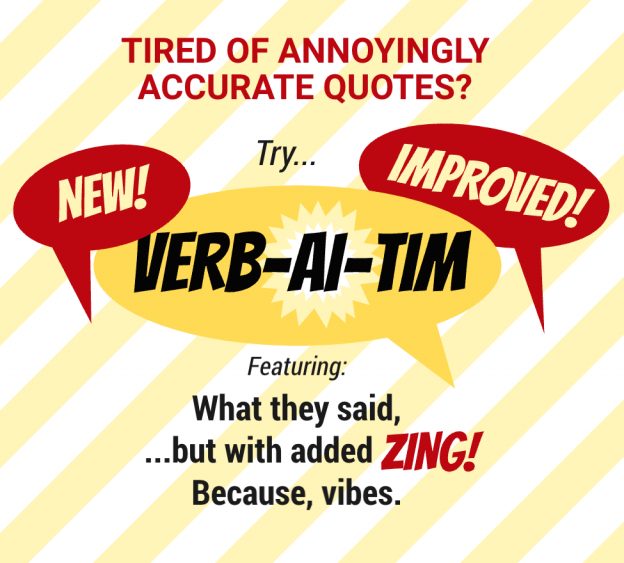
Verbatim AI quotes image

Verbatim vs. vibe-quoting

Verbatim quotes have been part of every research output I’ve worked on. They bring truth to power. So long as they are accurate.

On my last project I prompted an LLM to act as research assistant. One task was identifying key themes from interview transcripts. Interviews I’d conducted myself. I asked for 2-3 verbatim quotes to support each theme.

…and out they popped.

The themes were ringing true, but… in scanning the quotes, I found occasional words I couldn’t remember being said during the interviews. What the actual?

I called out the AI on this and asked for an explanation. It’s one I believe relevant well beyond the world of research…
Continue reading

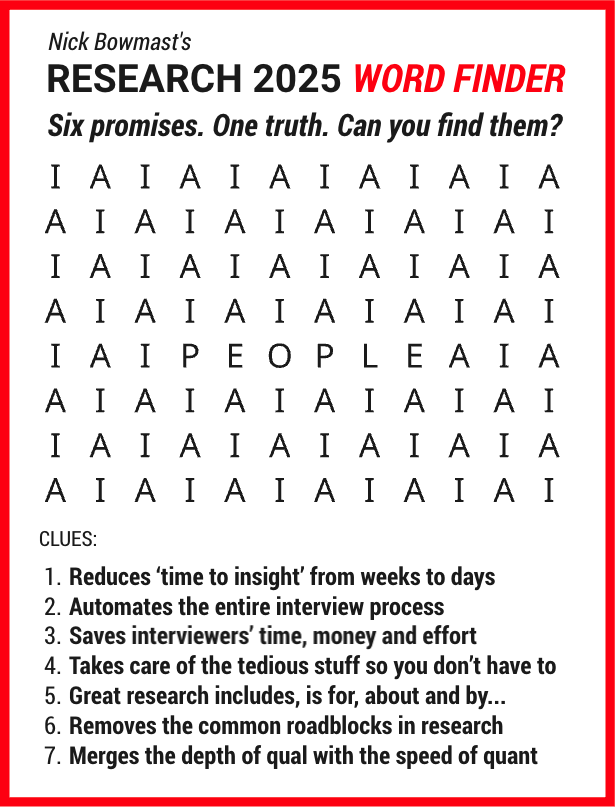
AI word finder graphic

2025 Research Word Puzzle

For your puzzling pleasure, I present six promises and one truth.

AI platform providers make a lot of promises to those engaged in qualitative research. Offering endless webinars, Q&As, free demos, beta groups, and tutorials galore in the hope we’ll choose their platform. Always with promises of speed, efficiency, scale*, economy.

But hidden in all the noise is a simple truth.

It’s buried in my Research 2025 word finder puzzle. Can you find it?

Continue reading

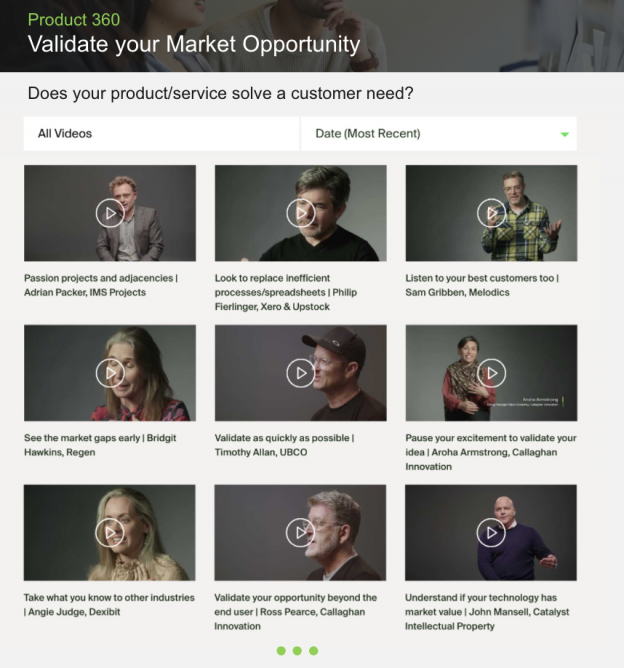
Callaghan Market Validation

What does market validation mean? It depends … on who you ask.

I learned this through a research brief from Callaghan Innovation, interviewing NZ business founders to find answers lying between their anecdotes, commercialisation truth bombs, hits and misses. 

Later, Ross Pearce and Aaron Dustin produced a bucket of super-targeted video resources to help others learn what it takes, through a range of (sometimes conflicting) experiences. 

Continue reading

Bowmast-Design-Research-Mapping

Looping the Loop? (Lessons Learned in an Aircraft Hangar).

Drawing looped lines began with a task: uncovering how visitors moved through an aviation museum. We aimed to gain insight from patterns, pathways, and pause-points as part of our visitor experience strategy research.

I’m a fan of designing analog and game-based activities when working with kids. Despite abundant technology for tracking movement of objects in space, I deferred to pen and paper. It went super well and I learned a few things from this low-tech approach. 

I’m sure this could work as well for retail or other environments where you want to get a feel for the experience and influencing factors, rather than purely counting ‘who goes where?’ or whether their journey is a loop or zigzag. 

We stopped family groups in the gift shop as they exited the museum, using a simple map and coloured sharpies as a springboard to engage in a two-to ten-minute chat.

Here’s what I learned from engaging with the kids and their parents:

  • These maps were yet another ‘tool for talking’ and a good one at that. Especially with family groups of different ages.
  • Dialogue, not data. Marks on maps didn’t always match our observation, but supported a far richer conversation.
  • A scratch-built floor plan with exaggerated visual cues and labels works better than an architect’s plan.
  • Group dynamics and kids of different ages revealed individual memories of a shared experience, an excellent talking point.
  • A dozen of these saw us spotting patterns. Two dozen allowed us to spot the nuances. We did ~30 over a busy peak.
  • This exercise generated many hypotheses, sharpening our objectives for remaining observations and depth interviews.

If you’re planning a similar study and would like to chat, I’m happy to share beyond this or help you plan. 

[Congratulates self for avoiding aircraft puns]

Bowmast Visualising Design Research Journey Map

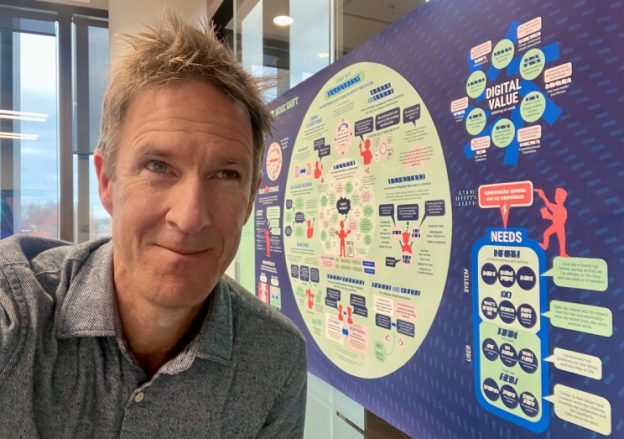
I’ll have what she’s having… (When visuals go viral)

It’s validating when clients see my research visuals elsewhere and ask for ‘The same, but for our stuff’.

It’s partly because they are social.

They get people talking. Especially when pinned up in common spaces (hello team kitchen).

And teams need tools to talk. These visuals become prompts for other business verticals or departments to wish for a specific view of THEIR customer’s world, or the same customer’s relationship with THEIR product or brought to life in a similar way. 

It’s almost a ‘When Harry met Sally’ moment and can happen within or between businesses. 

Got me thinking… so what other mediums enjoy a viral effect like this?

I’m picking film might be a contender, but do any other mediums gain such a response?

How do you build contagion into your outputs?

What’s made you want what they’re having?

If money talks, what does it say to a research participant?

A handful of cash used as incentives in design research.

NZ $50 notes, participant-bound. The bird on each one is a native Kōkako. Voted bird of the year in 2016. Ridiculous.

No, I haven’t won the lottery, the $$$ in the clip are to pay research participants. That’s business as usual for field research, and I’ve distributed hundreds of thousands of dollars in my time. It’s either cash or a voucher equivalent, and it’s always appreciated. 

It’s routine to pay research participants, but I believe the When? and How? of doing this can influence their behaviour. This is why I always pay participants with folding cash within Continue reading

Customer interview around a dining table in Tokyo, Japan.

Design research using simultaneous translation

Three seconds later – it’s like firewood.

This is the answer to the question – How do you interview people in a different language?

… A question I’m asked often.

When working in markets where English isn’t commonly spoken I use simultaneous translation. My client and I listen in English to a conversation in the local language. Translation is a skill I have respect for, and it’s indispensable for in-market customer insight work.

While a well-briefed bilingual interviewer interviews people in their local language, the translator relays the conversation in English through a mic and earbuds, delivering aural goodness on about a three second delay. Continue reading

Zane Lowe. Learned to listen.

Listening. How hard can it be?

Ask Global Creative Director at Apple Music, who says they’ve ‘really only just learned to listen’.

Zane Lowe has been described as New Zealand’s most successful music export, one of the UK’s top radio broadcasters and is now the creative force behind Apple Music.

Fancy. But as a professional listener myself, it’s the thousands of insightful interviews he’s racked up with artists that interest me. And what helped him learn to listen. Continue reading

Spreads900

Zoompathy. Coming to a research project near you?

One of the biggest points of value in conducting qualitative research – putting yourself in your customers’ context – has been wiped off the table, right when it’s most needed.

In a time where it’s never been more important to bring an understanding of people’s mindset, behaviour and expectation to bear on product development, while business and public organisations are rethinking service delivery for their market, I’m concerned.

I’m concerned those offering research as part of their service may default to the possible at the expense of the valuable. 

Context matters.

Those who’ve read my book will know how important I believe context, and ‘being there’ contributes to the quality and reliability of the work we do.

A couple of chapters in, I say this:

context1

And among many others, I give this example:
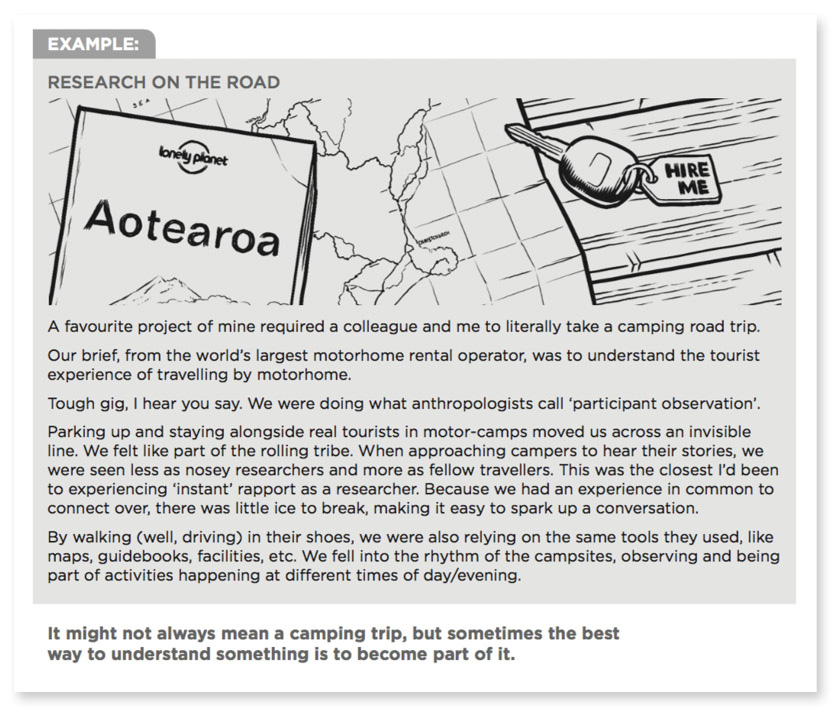
context2

… but right now, when researchers most need connection with people in their world, physically being there is a challenge.

Remote to the rescue?

Business continuity is important, and if there was ever a time for remote research, it’s now. Like many researchers working over the past few weeks, I recently had a project switch from in-person to remote – a dozen interviews via video – with valuable outcomes. I could see the tradeoffs, they were manageable, and I made sure the client understood these.

But I’ve started to see researchers and agencies announcing ‘we’re still open for business’ promoting remote-only research approaches, focusing on the benefits, but glazing over any of the tradeoffs.

Remote approaches have always been part of the research toolbox, though usually as a complement to in-person work or to add; reach, scale, frequency, specific types of participants or to include communities/individuals for whom this kind of connection works best.

However, just as speed and democratisation have influenced the shape of research opportunities – favouring a rapid over rich variety of empathy – I’m picking clients may get a taste for the convenience and economy of remote research without always realising what they’re sacrificing in terms of data quality and depth of experience which comes from being with the customer in the moment.

Yes, remote approaches will be a blessing to our collective practice for some time and it’s exciting to think of the creative approaches which will emerge from these constraints, but short-term reliance on research methods without explaining the tradeoffs may risk training our clients to accept what appears to be a more convenient option. As design-at-pace sometimes seems more user-scented than centered, we might see empathy be replaced by Zoompathy (I really hope this term doesn’t catch on).

So, now what?

I believe current constraints bring an opportunity to highlight the value of contextual fieldwork. But as we’re adopting and applying remote approaches where we otherwise might not have, perhaps we should:

  • Reflect on and amplify your experiences from the field. As anecdotes with colleagues, or in conversation with clients to maintain the status and value of face-to-face and contextual work. Steve Portigal’s growing collection of ‘War Stories’ offer plenty of fodder, but I’m picking you have your own.
  • Feel the edges of what works well, and what doesn’t. For different research questions, circumstances, communities and contexts,
  • Recognise the gap between being there and not. What’s missing, and what other ways might we fill it,
  • Acknowledge the limits as well as the benefits. Beyond the convenience of reduced budget and practicalities – into matters of access and inclusion, privacy, confidentiality, safety and scale.
  • Highlight inefficiencies or insensitivities we may have normalised though extensive international travel. Limiting unnecessary travel is a good thing for all our futures.
  • Discuss and document what you’ve learned. With your team and your client.
  • Share with the research community.  For example, Ex colleague Sarah Rink in Barcelona has shared a guide to remote research, written from a UX research perspective, talking through the challenges of capturing non-verbals and the inherent tech distractions.

Together, by remaining adaptable but sharing our learnings we can help remote become a more valuable part of the toolbox, while ensuring the undeniable value of in-person work continues to be used to best effect when this is once again possible, and for the situations it’s most appropriate.

Please add your experiences or any links to articles in the comments, we all stand to gain, especially our clients.

Remotely yours,

siggy